
Growing up in Lebanon during my teens, I experienced firsthand how water can shape daily life. Tap water was not safe to drink, so bottled water became a necessity. Additionally, during heavy rains, flooding often closed roads, damaged cars, and left neighborhoods isolated for extended hours, or even days. These experiences profoundly shaped my academic and professional path, leading me to pursue a PhD in Environmental Science at Toronto Metropolitan University (TMU), where my research bridges water quality, public health, and green infrastructure. My interest lies in exploring innovative and sustainable water management strategies that enhance resilience to climate change.
In 2013, southern Alberta experienced Canada’s costliest natural disaster, where catastrophic flooding displaced over 100,000 people and caused nearly 6 billion dollars in damage. Beyond the immediate physical destruction, the floods had lasting environmental and public health consequences, including increased anxiety and mental health challenges among affected populations. This event highlighted the vulnerabilities of Canada’s urban infrastructure and reinforced the need for adaptive, nature-based stormwater management strategies to mitigate these impacts.
Today, Canada continues to face rising flooding risks due to climate change, rapid urbanization, and aging grey infrastructure. Shorter and more intense rain events now frequently exceed the capacity of stormwater systems, contributing to recurrent urban flooding. Intact Insurance estimates that flooding caused an average of 1.8 billion dollars in insured losses annually between 2009 and 2017, a figure expected to rise with continued urbanization.
Traditional stormwater infrastructure alone is proving increasingly inadequate, highlighting the need for scalable, equitable, and climate-resilient green infrastructure solutions. Blue roofs, engineered systems that temporarily retain rainwater on rooftops, represent a promising innovation in this context.
Blue Roofs and Their Role in Urban Resilience
Blue roofs, or modified rooftops designed to retain water during precipitation events, help reduce runoff volumes and delay peak discharge, alleviating stress on municipal sewer networks. Blue roofs can range from simple gravel-filled trays to sophisticated sensor-controlled systems that optimize rooftop water storage and release. In addition to stormwater management, blue roofs provide multiple benefits, including mitigating urban heat, reducing energy demands, and creating opportunities for water reuse.
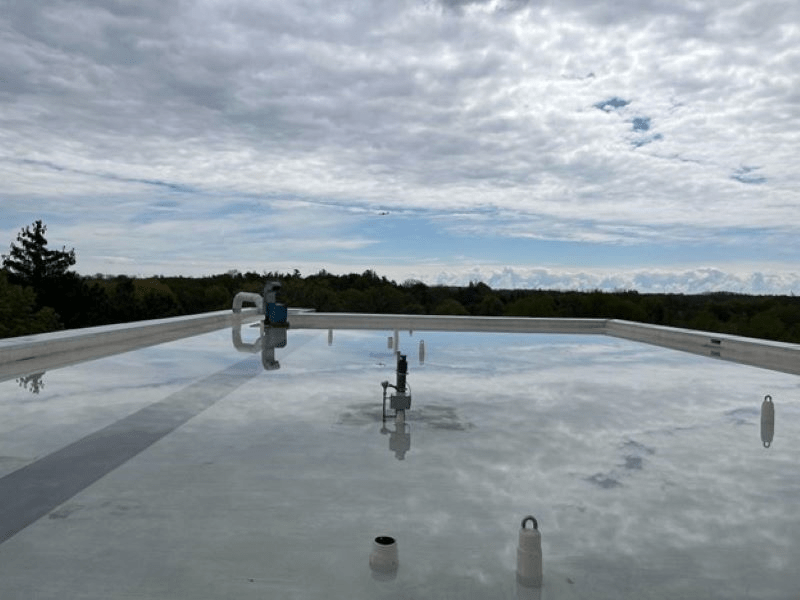
In Canada, blue roofs remain largely underexplored. Credit Valley Conservation (CVC), an environmental organization, constructed the first Canadian Standards Association (CSA)-compliant Smart Blue Roof, demonstrating how green infrastructure can mitigate flood risks and enable rainwater harvesting for non-potable uses such as toilet flushing. This system serves as the case study for my doctoral research, conducted in collaboration with CVC and TMU’s Urban Water research team, which integrates expertise in civil engineering, architecture, and public health.
Key Features of the CVC Smart Blue Roof System
The Smart Blue Roof at CVC is a versatile system designed to address urban water management challenges. As a proof of concept, it covers a surface area of 344 m² and can store up to 40,000 liters of rainwater for non-potable uses such as toilet flushing and landscape irrigation. Its seamless PMMA (polymethyl methacrylate) membrane provides insulation and ensures efficient water retention. Advanced treatment systems, including filters, ultraviolet lamps, and chlorine, maintain water quality for safe reuse and ensure compliance with municipal, provincial, and national requirements. Smart valves and a recirculation system dynamically regulate water flow based on weather conditions and building requirements. Together, these features enable the system to mitigate flooding risks, conserve water, and enhance energy efficiency.
The potential of Smart Blue Roof systems goes far beyond single-building applications like the one at the CVC headquarters. When adopted across streets or entire neighborhoods, these systems can:
- Decrease runoff and help manage stormwater more effectively.
- Enable on-site water reuse for applications including toilet flushing, irrigation, and many more.
- Mitigate urban heat by cooling the surrounding area through evaporative cooling.
Thus, incorporating Smart Blue Roofs into broader urban design and planning strategies can substantially strengthen municipal resilience to extreme weather and advance sustainable water management initiatives.
Policy Challenges and Prospects
Despite their potential, blue roofs face regulatory barriers under current Canadian building codes. The National Building Code of Canada (NBC, 2020), National Plumbing Code (NPC) (2020, Division B, Section 2.4.10.4), and Ontario Building Code (OBC) (O. Reg. 332/12) all require rooftop water to be drained within 24 hours, known as the drawdown time, to protect roof structures and prevent stagnation and microbial growth. While this precaution is well-intentioned, it limits blue roof performance by preventing longer-term water storage and reuse, especially during back-to-back storm events.
These regulations were designed to prevent mold, mildew, and overall water fouling. However, they do not account for the advanced treatment technologies such as filtration, UV disinfection, and chlorination that are now integrated into Smart Blue Roof systems. As a result, the codes may be overly conservative, restricting the implementation and scalability of this promising infrastructure. This highlights a clear policy gap between building regulations and evidence-based assessments of public health risks associated with stored rooftop water.
Additional challenges, many of which are shared with other emerging forms of green infrastructure, relate to long-term cost–benefit considerations, maintenance needs, and operational constraints. Blue roofs generally have higher installation costs compared to conventional grey infrastructure, and they do not provide immediate financial returns. However, as noted earlier, their long-term benefits extend beyond monetary gains, including enhanced stormwater management capacity and broader environmental co-benefits.
Blue roofs also require ongoing maintenance and monitoring to ensure system performance and water safety. This includes verifying that treatment components are functioning properly and that roof membrane layers and other structural elements remain intact and are not degrading over time. Finally, blue roofs face operational limitations in cold climates. They are not fully functional during winter or when temperatures fall below freezing, since water cannot be recirculated under these conditions. In such periods, the system effectively operates as a conventional roof: valves may remain open to allow rainwater to flow directly to the cistern without being temporarily stored on the roof.
Research Overview
Thus, my PhD research addresses this gap by evaluating the safety, performance, and policy implications of smart blue roofs in Canada. The project, consisting of public health experts, civil engineers, and architects, aims to generate empirical evidence to inform building codes and watershed governance, ensuring that water retention strategies are both safe and effective. While the current 24-hour drawdown requirement is precautionary rather than evidence-based, this research tests the hypothesis that blue roofs equipped with appropriate treatment systems such as filtration, UV disinfection, chlorination, and recirculation can safely retain water beyond 24 hours without compromising public health or structural safety. Adopting performance-based standards could therefore enhance both stormwater management and water reuse potential.
This research contributes to advancing sustainable water management by:
- Providing microbiological and physicochemical data on stored rooftop water quality
- Identifying safe operational thresholds for extended water retention
- Bridging the disconnect between engineering innovation and policy frameworks
- Supporting evidence-based, performance-oriented building standards that enhance climate resilience and equity
By integrating technical monitoring, public health assessment, and policy analysis, the research promotes the broader implementation of blue roofs as cost-effective, climate-adaptive urban infrastructure that can reduce flood risks like those experienced in southern Alberta and across Canada.
Data Collection & Methods
Sampling took place across two field seasons (May-October 2024 and April-October 2025). Four grab samples and one composite sample were collected from the blue roof at CVC, along with pre- and post-treatment samples from the cistern and treatment line. All samples were transported to the Microbiology Laboratory at TMU for analysis under aseptic conditions.
On-site measurements included mosquito dipping and chlorine residual testing. In the lab, physicochemical parameters (pH, temperature, TDS, UVT) and microbiological indicators (total bacteria, coliforms, E. coli, Salmonella, Legionella, Enterococcus spp., and Listeria) were analyzed following Standard Methods (APHA, 2017).
Blue roof water was assessed against NSW water quality criteria (E. coli ≤1,000 CFU/100 mL; pH 6.5–8.5), and post-treatment water was compared to Health Canada and provincial guidelines for non-potable uses such as on-site urinal flushing and irrigation.
Preliminary Findings
While data analysis is still underway, several key observations emerged from the two field seasons conducted in 2024 and 2025. Initial results indicate that advanced blue roof systems equipped with integrated treatment processes, such as consistent chlorination and water recirculation or mixing, can retain water on the roof for more than 24 hours while maintaining public health safety standards and ensuring structural integrity.
Microbial analyses showed that bacterial growth was sustained in roof-stored water when disinfection was inconsistent or absent. However, when chlorine residuals were maintained above 0.5 mg/L, no fecal coliforms were detected, indicating effective microbial control. Furthermore, the combination of consistent mixing and chlorine treatment inhibited mosquito development.
Findings highlight that there is no one-size-fits-all approach to the blue roof treatment system, as optimal design depends on site-specific conditions such as roof design, water use, and environmental or external factors. For the CVC case study, maintaining a consistent chlorination residual (above 0.5 mg/L) on the roof proved essential to prevent uncontrolled microbial proliferation.
Conclusion and Insights
Overall, these results challenge the conventional assumption that blue roof water must be released within 24 hours to ensure safety. They demonstrate that with proper treatment and recirculation, blue roofs can safely store water for extended periods, transforming them from short-term stormwater control measures into sustainable urban water reuse systems. This finding has the potential to redefine design standards, influence the NBC, NPC, and OBC, and reshape how cities manage rainwater in a changing climate.
From the floods of my youth to the Smart Blue Roofs of today, this research shows how innovative water management can safeguard communities, conserve vital resources, and build a future where cities adapt effectively to the challenges of a changing climate.
About Author: Dima Balaa

Dima Balaa is a PhD candidate in the Environmental Applied Science and Management program at Toronto Metropolitan University (TMU). Her research focuses on the intersection of water quality, treatment systems, and public health. She holds a master’s degree from TMU, where she explored public risk perceptions of microplastics and nanoplastics in drinking water using Reddit discourse analysis and expert interviews.
Currently, Dima is leading public health research within the interdisciplinary Credit Valley Conservation (CVC) Smart Blue Roof project, investigating microbial levels in standing water to ensure compliance with Ontario’s recreational water standards. Her work involves evaluating health risks across progressive time intervals, from 24 hours to one week, and identifying treatment needs using microbial and water quality indicators. By integrating public health perspectives into engineering and architectural design, Dima aims to inform potential refinements to the Ontario Building Code’s 24-hour drawdown limit and contribute to advancing sustainable water reuse strategies and resilient urban design.
 IWA YWP Canada