
Graphical abstract for the blog post
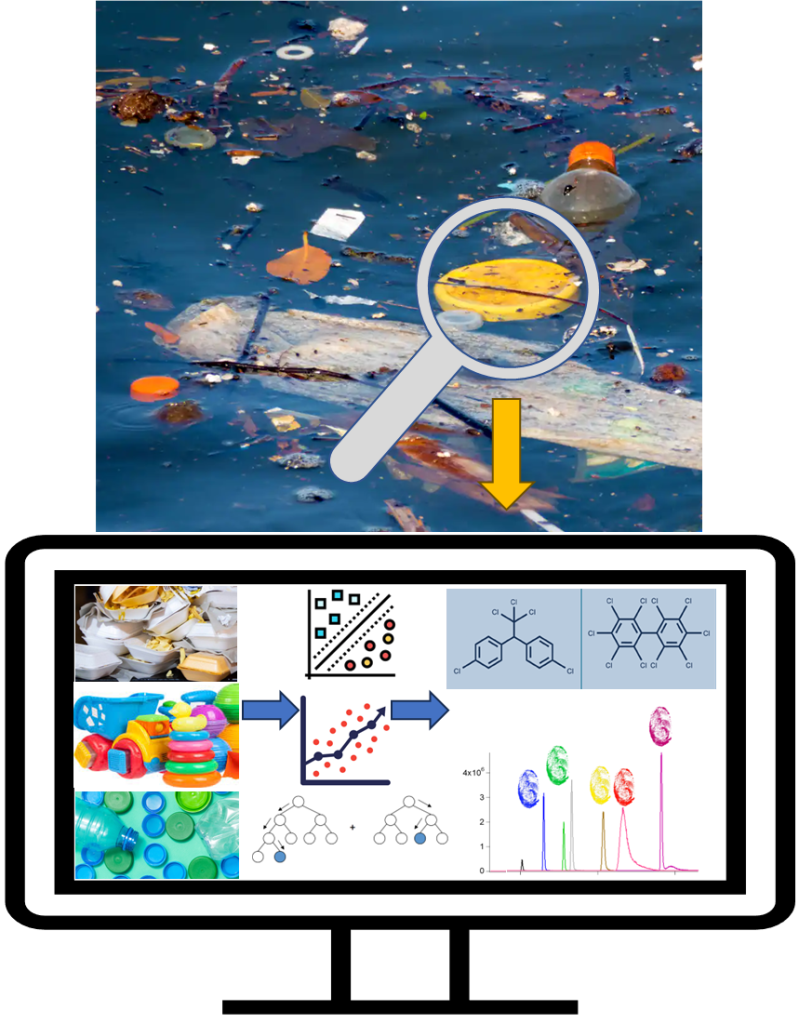
Keywords: microplastics, non-targeted fingerprinting, clustering analyses, supervised machine learning.
What are environmental forensics and chemical fingerprints?
Looking at the term “fingerprints” or “forensics” in the title of this blog, it probably reminds you of a detective TV show that you have seen or a book that you have read, for example, Brooklyn 99 or about the famous detective Sherlock Holmes. In these scenarios, the detective will search for the criminal’s fingerprint and use it to identify the criminal. Similarly, in environmental forensics, the goal is to link local pollution to responsible polluters before further harm is done.
Application of environmental forensics in plastic pollution:
In my research, I focus on the application of environmental forensics in plastic pollution. Plastic pollution has been repeatedly identified as a massive global issue. Moreover, ecotoxicological research has identified thousands of toxic substances leaching from plastics into the environment, including our air, water, and soil. Since the number of chemicals with unknown toxicity is increasingly being used in the production of various types of plastic products and ends up polluting our environment, we urgently need a tool to effectively does source-tracking and develop mitigation and regulatory actions for these hazardous chemicals.
Why is environmental source tracking of plastic contaminants so difficult?
A prominent challenge for chemical forensic studies, which seek to identify the source of a chemical/mixture of interest, is that 10 to 100,000s of chemicals exist in the environment. However, current provincial and federal monitoring programs screen for only a few hundred compounds (see here and here). Since these monitoring programs ignore >99.9% of all chemical features present, the chances of identifying the specific chemicals driving adverse environmental phenomena are small. Therefore, robust chemical forensic strategies are needed for routine monitoring that utilize broader chemical space. Moreover, when it comes to plastic pollution, we have challenges where plastic and its associated contaminants can:
- be transported far from the source of pollution,
- be made from a diverse suite of chemicals, both come from the polymer backbone and are added as plastic additives during the manufacturing of plastic products, and
- be exposed to environmental weathering and altered their chemical fingerprints, thus making source tracking more challenging.
Therefore, there is an urgent need for an effective source tracking tool. In my research, a computational fingerprinting workflow for environmental forensics of plastic was developed with several goals in mind:
- What are the chemical fingerprints and their patterns in locally used plastic products?
- How does the concentration of chemical fingerprints in complex contaminant mixtures correlate with the sources of contamination?
- What is the prediction accuracy of the automatic identification of the sources of contaminants?
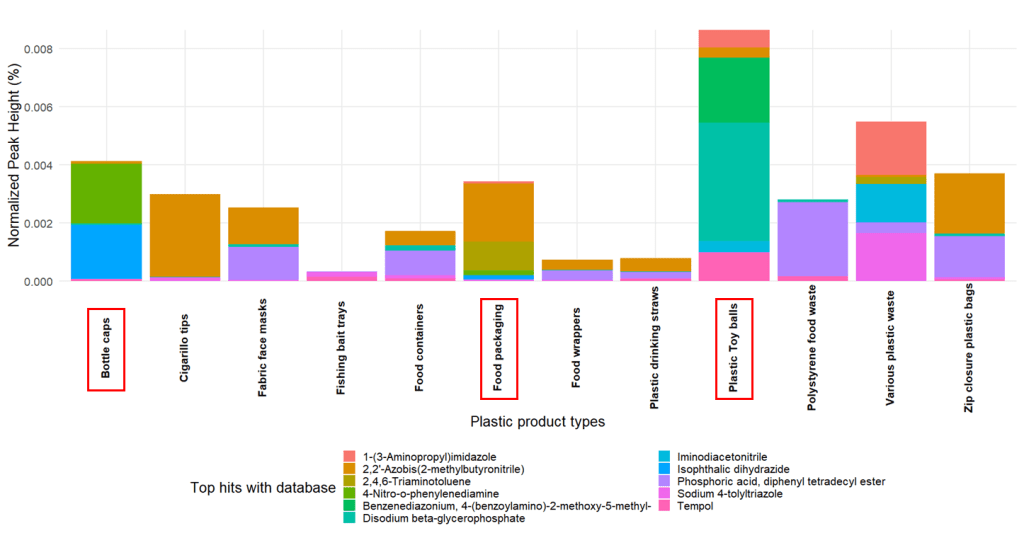
List of representative chemical fingerprints and their functions, associated industry, and plastic products
| Substance name | Functions | Industry | Associated products |
| 2,2′-Azobis(2-methylbutyronitrile) | Catalyst, Colorant, Crosslinking agent, Initiator, Monomer, Other Processing Aids | Automotive | Food packaging, Cigarillo tips |
| Phosphoric acid, diphenyl tetradecyl ester | Flame retardant, Plasticizer | Not reported | Polystyrene food waste |
| Isophthalic dihydrazide | Not reported | Food-contact plastics, Packaging | Bottle caps |
| Benzenediazonium, 4-(benzoylamino)-2-methoxy-5-methyl- | Not reported | Not reported | Plastic toy balls |
| 1-(3-Aminopropyl)imidazole | Colorant | Automotive, Building & Construction, Electrical and Electronic Equipment, Household items, Furniture and other, Textiles | Plastic toy balls |
| Iminodiacetonitrile | Intermediate | Not reported | Plastic toy balls |
| Disodium beta-glycerophosphate | Other Processing Aids | Not reported | Plastic toy balls |
| 2,4,6-Triaminotoluene | Crosslinking agent | Not reported | Food packaging |
| 4-Nitro-o-phenylenediamine | Not reported | Not reported | Bottle caps |
Throughout my research, we found that the plastic products with the highest concentrations of plastic additives are food-contact materials (Food packaging, bottle caps) and children’s toys (plastic toy balls). Moreover, there is a lack of publicly available information on the functions and associated industries of these representative chemical fingerprints.
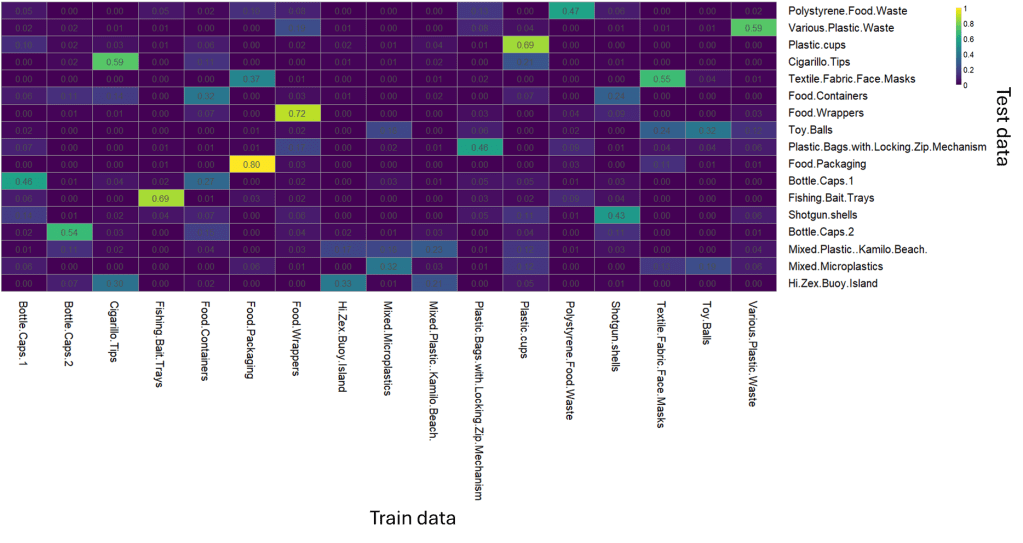
The plastic product type in the test data (environmental plastics) was successfully traced back to its store-bought equivalents for the following plastic product types: food packaging, plastic cups, and fishing bait trays (with a value of 1 indicating 100% confidence). With this result in mind, we can confirm that the identified chemical fingerprints are stable enough and can be considered as representative for environmental source tracking of these plastic products.
What are the Next Steps?
Moving forward, the developed computational fingerprinting approach can provide a robust workflow for analytical chemists to explore chemical fingerprints for their specific contaminants of interest. The generated product- or producer-specific information on microplastic and plastic additive emissions can help policymakers develop chemical management strategies and set regulatory parameters for microplastics. It can also inform consumer choices, potentially reducing emissions and exposure to hazardous contaminants. Identifying the producers or specific product types that contribute to local environmental microplastic loads can catalyze regulatory actions to reduce microplastic emissions and enable cost recovery from polluters. Moreover, localized information on the emission sources of specific microplastics and associated additives can inform the adaptation of wastewater treatment techniques to increase the removal efficiency of these contaminants.
Lead Editor: Elham Soleimanian

About Author:
Huy Nguyen
Contact email: huy.manh.nguyen@torontomu.ca
is a fourth-year PhD candidate in the Environmental Science and Management program at Toronto Metropolitan University. With his interest and passion for all things ecology, chemistry and data science, Huy is currently developing a computational fingerprinting workflow for automated environmental source tracking of complex contaminant mixtures, particularly focusing on plastic pollution via plastic additives. Outside of his PhD research, he works as a climate change coordinator for TMU SciXchange and organizes outreach activities revolving around the theme of climate change and emerging contaminants for students of all ages.
 IWA YWP Canada